
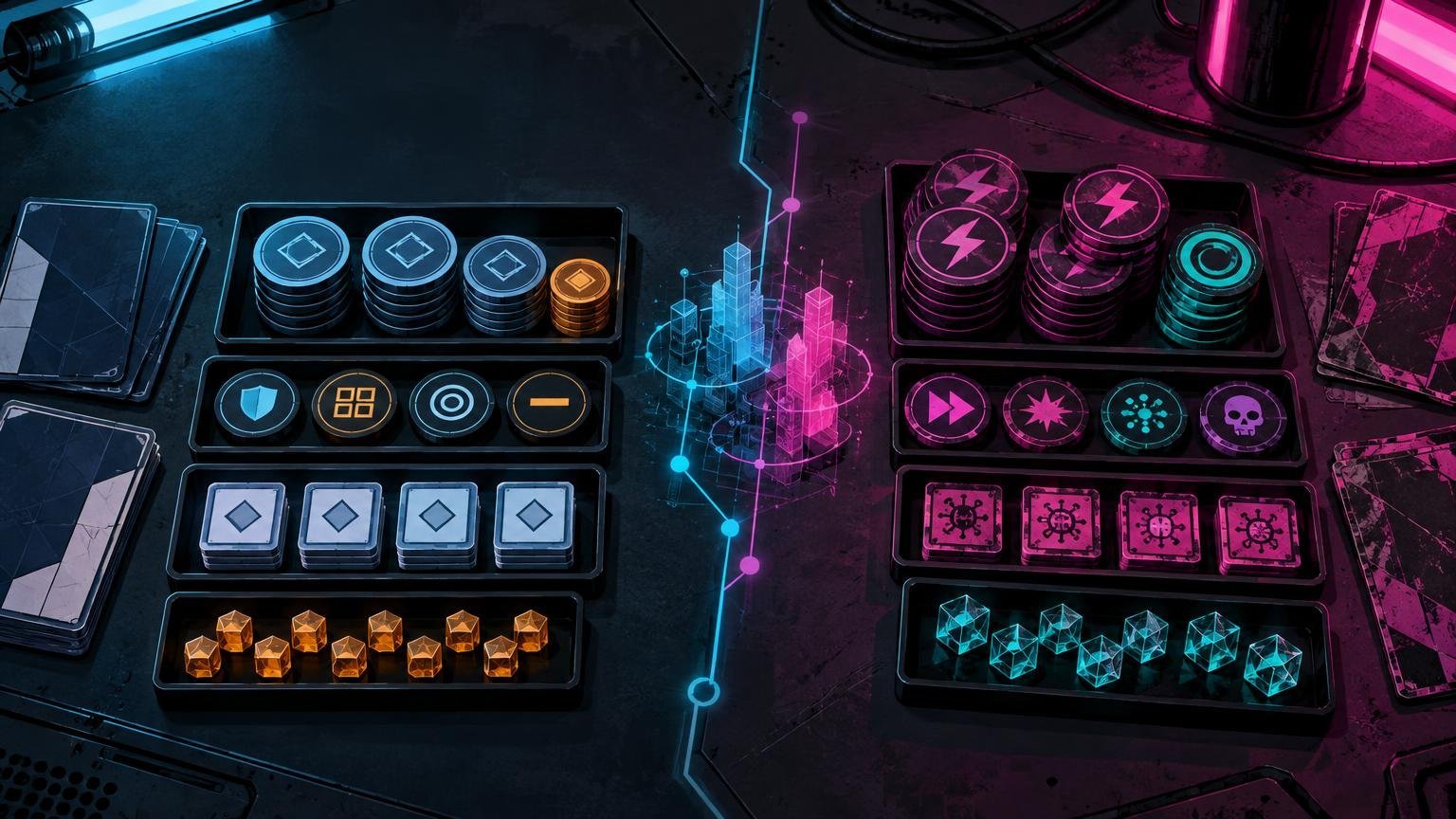
A useful set of Netrunner print-and-play tokens does not need to imitate a particular commercial product. It needs to make the board readable. At minimum, prepare markers for credits, clicks, advancement, tags, core damage, bad publicity, virus counters and generic card counters. The best kit gives the common resources plenty of space while using flexible markers for effects that appear only in certain decks.
Under the current Netrunner Comprehensive Rules, “counter” and “token” are interchangeable terms. They are game pieces, or equivalent representations, used to track resources, effects and statuses. The rules identify credit, click, tag, bad-publicity, core-damage, advancement, virus, power, agenda and condition counters. You can therefore use printed circles, wooden cubes, dice, poker chips or another clear system. The information they represent matters more than the material.
The essential shared token kit
Start with the information that appears in almost every game. Credits and clicks deserve the most attention because players read them constantly when evaluating runs, rezzes and scoring windows. A Runner who cannot quickly judge the Corp’s available credits has to spend effort decoding the table instead of deciding whether to run.
| Marker | Practical starter quantity | What it needs to show |
|---|---|---|
| 1-credit markers | 30–40 | A clearly readable single credit |
| 5-credit markers | 8–10 | A distinct value that cannot be mistaken for one credit |
| Click markers | 8–10 | Available and spent clicks for both players |
| Advancement markers | 12–20 | Progress on installed cards without looking like credits |
| Virus counters | 12–20 | Counters placed on virus cards or tracked by card effects |
| Tag and core-damage markers | 8–12 of each, or reversible markers | Two different Runner statuses that must remain easy to distinguish |
| Bad-publicity markers | 4–8 | The Corp’s current bad publicity and whether recurring credits were spent |
| Generic counters | 15–20 | Power, agenda, condition and card-specific counters |
These quantities are a starting heuristic, not a rules requirement. Counter-heavy decks may need more virus, power or advancement markers, while introductory decks may use far fewer. The shared bank is unlimited under the rules, so running out of a physical counter does not stop a player from gaining or placing it as long as the game state remains clear. Dice or spare generic markers make sensible overflow tools.
Keep credits, advancement and card counters visually distinct
Credits and advancement counters often occupy different areas, but relying only on location creates avoidable ambiguity. Give them different labels, shapes or border patterns. A token marked “1¢” should not look identical to a token marked “ADV,” especially when both can appear around a remote server.
Apply the same principle to tags and core damage. Both affect the Runner, but they create different risks and decisions. Labels are more reliable than color alone. Combining a word or abbreviation with a distinct symbol also makes the kit easier to read under uneven lighting or for players who do not distinguish every color easily.
Generic counters handle the long tail of Netrunner effects. Print several numbered or neutral markers rather than making a unique token for every card. If a card uses power counters, for example, place a labeled power marker beside it and use a die when the number grows. The goal is to preserve information without turning the table into an accessory catalog.
Use clicks as a tempo display, not loose accounting
Click tracking should show both how many actions remain and how much of the turn has already been spent. A row of double-sided available/spent markers works well. Moving a single marker down a numbered track also works, provided both players can see it.
This is more than bookkeeping. Visible clicks explain the shape of a turn. A Runner with one click left has different run and tag-removal options from a Runner with three. A Corp’s remaining clicks determine whether it can install, advance and score after the Runner exposes a weakness. Good click markers keep those opportunity costs in view.
Official cards and community token files are different resources
Null Signal’s official print-and-play downloads provide card PDFs. Its purchase guidance describes downloadable files arranged nine cards per page, while its FAQ explains that the files omit card backs and are intended for opaque sleeves with backing cards. That card workflow should not be mistaken for an official printable token sheet.
Downloadable token sheets, poker-chip labels, alternate designs and 3D-print files are generally community projects. The Near Earth Hub DIY Tokens directory collects several of these options in one place. Check each project’s license, instructions and file format before printing, and describe the finished pieces as community-made or unofficial rather than as original game components.
Null Signal has also listed a physical 118-piece token set. Its published contents provide a useful completeness check: credit and advancement markers, five-credit tokens, click trackers, virus counters, generic counters, tag and core-damage markers, and bad-publicity markers. You do not need to reproduce that exact quantity or design, but the list shows which game states a general-purpose kit should be ready to represent.
A simple print-and-assemble workflow
- Choose a token sheet with text and symbols that remain readable at the intended size. Avoid designs that communicate value through color alone.
- Print one test page at actual size. Confirm that small labels such as ADV, TAG and CORE remain legible before producing the full set.
- Mount paper tokens on chipboard, heavy card or inexpensive discs if you want pieces that are easier to pick up. Plain paper works for a temporary teaching kit but tends to slide and curl.
- Use single-sided pieces unless you can align the two faces reliably. Reversible tokens save space only when players can tell which face is active.
- Sort the finished markers by function. Keep shared credits and generic counters in the center, with click and status markers near the relevant player.
- Test the kit with a busy board. Replace any pair of markers that becomes difficult to distinguish across the table.
If you are producing cards at the same time, treat that as a separate job. Finish the card list, quantities and sleeve plan using a repeatable process such as printing a Netrunner deck from a decklist, then assemble the shared token kit. Separating those tasks makes missing cards and missing counters easier to notice.
What changes for organized play?
Current Null Signal Organized Play policy treats tokens and counters as representations of game-state information. They must not obscure information, and an opponent may request a reasonable change when a representation is unclear. Null Signal has also stated that third-party tokens remain legal at its Organized Play events. Official branding is therefore not what makes a token usable; clarity does.
Tokens are also different from card proxies. Organized Play policy defines a proxy as a stand-in for a legal card and gives card proxies requirements concerning information, sleeve fit and consistent deck feel. A printed credit marker is not a proxy card. Keep that distinction in mind when preparing an event kit.
Build for the decisions players need to see
A complete token kit is not the one with the most designs. It is the one that lets both players answer the important questions immediately: How many credits can the Corp spend? How many clicks remain? Is that card advanced? How many virus counters are available? Is the Runner tagged or carrying core damage?
Print generous supplies of credits, clicks and advancement markers first. Add tags, core damage, bad publicity and virus counters next, then fill the remaining edge cases with clearly labeled generic pieces. If every marker communicates one game fact without explanation, the kit is doing its job.
Frequently Asked Questions
Which tokens does a basic Netrunner table need?
Prepare credits, clicks, advancement, tags, core damage, bad publicity, virus counters and generic counters. Generic pieces can represent power, agenda, condition and card-specific counters.
How many Netrunner tokens should I print?
Treat the article’s quantities as a starting heuristic, not a rule. Print the largest supplies of credits, advancement and generic counters, then adjust for the decks your group plays.
Are “token” and “counter” different rules terms?
No. The current Comprehensive Rules use “counter” and “token” interchangeably for pieces or equivalent representations that track resources, effects and statuses.
Can I use dice, cubes or poker chips instead of printed tokens?
Yes, provided every representation is clear to both players. The tracked information matters more than the material used.
What happens if the table runs out of a counter type?
The shared bank is unlimited under the rules. A physical shortage does not prevent a counter from being gained or placed when the game state can still be tracked clearly.
Do Null Signal’s official print-and-play card files include token sheets?
The documented official downloads are card PDFs. They omit card backs and are intended for opaque sleeves with backing cards; they should not be treated as an official printable token sheet.
Where can I find printable community token files?
The Near Earth Hub DIY Tokens directory collects community projects such as printable sheets, poker-chip labels and 3D-print files. Check each project’s instructions, license and format before using it.
Can third-party tokens be used in organized play?
Yes. Null Signal has stated that third-party tokens remain legal at its Organized Play events, but representations must remain clear and must not obscure game information.
Is a printed credit token the same as a proxy card?
No. A token represents game-state information. A proxy stands in for a legal card and must satisfy separate Organized Play requirements concerning information, sleeve fit and deck consistency.