
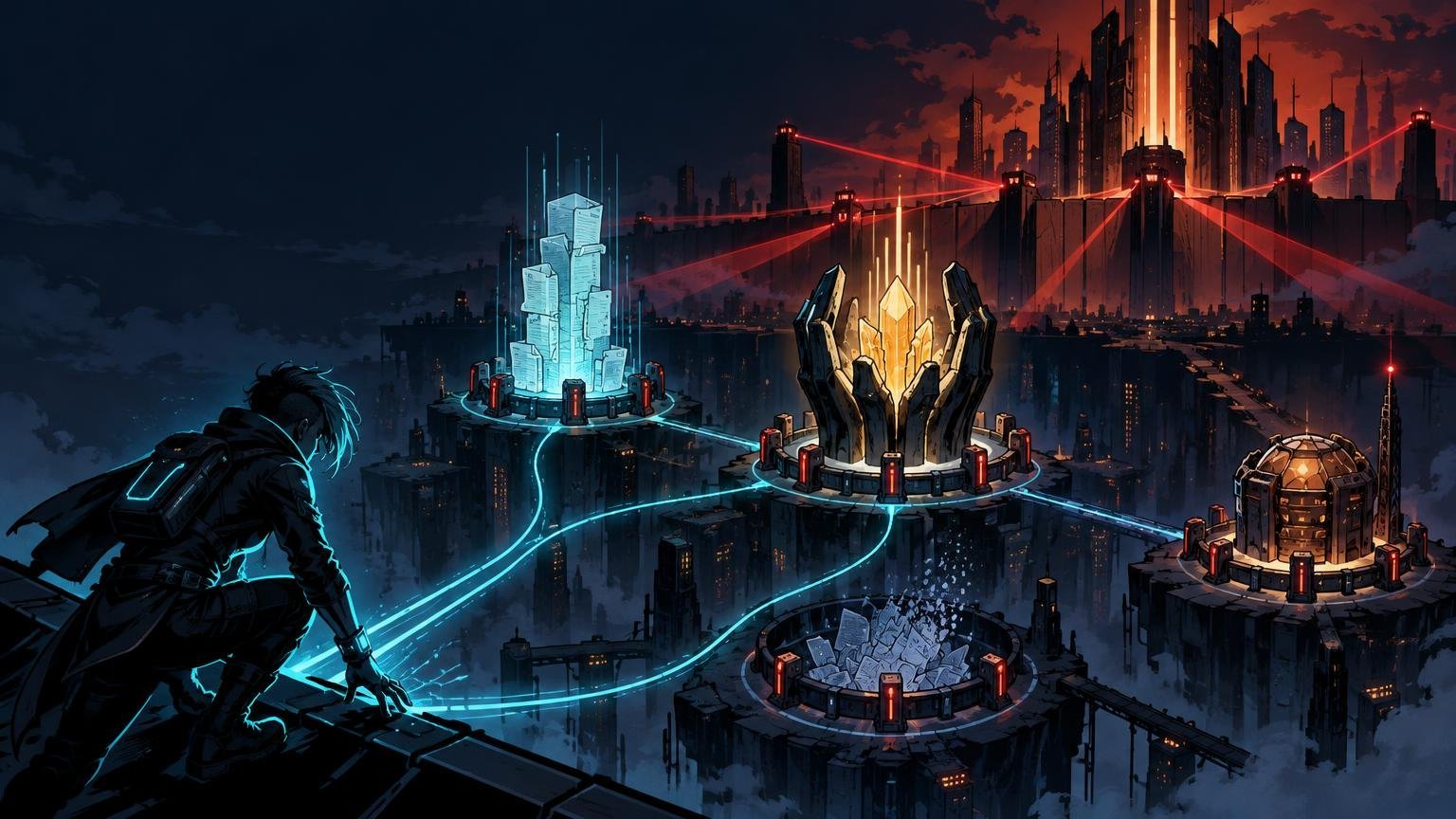
Netrunner has four kinds of places to run: the three central servers—HQ, R&D, and Archives—and any remote servers the Corp creates. The central servers connect to the Corp’s hand, deck, and discard pile. Remotes are where the Corp installs agendas and assets. Every server also has a root where certain Corp cards can be installed, while ice sits in front of the server and protects it.
That map is simple enough to memorize. The more useful lesson is that each server offers different information and pressure. A run on HQ tests the Corp’s hand, R&D pressures future draws, Archives checks the discard pile, and a remote challenges whatever the Corp has deliberately installed and defended.
The four server types at a glance
| Server | Connected area | Default breach | Why the Runner cares |
|---|---|---|---|
| HQ | Corp’s hand | One random card from the hand, plus eligible root cards | Tests cards the Corp currently holds and pressures agendas waiting in hand |
| R&D | Corp’s deck | The top card of the deck, plus eligible root cards | Threatens agendas before the Corp draws them |
| Archives | Corp’s discard pile | All cards in the discard pile, plus eligible root cards | Checks discarded cards and punishes unsafe agenda discards |
| Remote | No separate central area | Eligible cards installed in that remote’s root | Challenges installed agendas, assets, and upgrades |
The Corp always has HQ, R&D, and Archives. These are the central servers. A remote is any server that is not central; the Corp begins with none and normally creates one by installing a card into a new remote. There is normally no fixed limit on how many remotes the Corp may create.
Every server has a root
A server’s root is its innermost installation area. Ice is not installed in the root. It is installed in front of the server, where it protects the cards and central area behind it. If that distinction still feels slippery, the guide to ice and icebreakers explains what happens when the Runner approaches and encounters those defenses.
Central roots may contain upgrades, but they cannot contain agendas or assets. A remote root may contain one agenda or one asset, along with any number of upgrades. Only one region upgrade can be installed in a single root. This means a remote is not necessarily “one facedown card”: several facedown cards may be installed together, and some or all of them could be upgrades.
A server can also exist with ice but no cards in its root, or with root cards but no ice. At a checkpoint, a remote disappears only when it has neither root cards nor protecting ice. The Corp can also trash cards already installed in a root before installing a new root card, so an old remote can be repurposed rather than abandoned.
HQ: pressure the Corp’s hand
HQ corresponds to the Corp’s hand. On a normal breach, the Runner accesses one random card from that hand. The Runner does not simply point at the card they think is an agenda. Any eligible upgrades in HQ’s root are also accessed during the breach.
Running HQ asks whether the Corp can safely keep valuable cards in hand. Even when the Runner steals nothing, the run may reveal that the hand is agenda-light, expose an operation the Corp was saving, or force the Corp to spend credits defending HQ. Repeated HQ pressure can therefore change how readily the Corp draws cards or keeps agendas for a later scoring window.
R&D: pressure future draws
R&D corresponds to the Corp’s deck. A normal breach accesses its top card, plus any eligible cards installed in the R&D root. If an effect grants access to multiple cards from R&D, those cards are accessed from the top downward, one at a time.
R&D pressure matters because the Corp cannot score an agenda that never reaches a useful installation window. A single access is uncertain, but repeated breaches keep testing the top of the deck. The Corp must decide whether to reinforce R&D, race to score elsewhere, or accept the risk while spending credits on a different server.
Archives: pressure the discard pile
Archives corresponds to the Corp’s discard pile. By default, breaching Archives allows the Runner to access every card there, along with eligible cards in the Archives root. Facedown cards in Archives are turned faceup before access begins. Faceup cards there are normally open information, while facedown cards remain hidden from the Runner until that breach.
An undefended Archives is not automatically harmless. The Corp may discard agendas because of hand pressure, and card abilities can make an Archives run relevant even when no agenda is visible. For the Runner, the important question is whether checking Archives is worth a click now or whether another server offers more immediate pressure.
Remote servers: challenge the Corp’s claims
A remote has no hand, deck, or discard zone behind it. During a normal remote breach, the Runner accesses the eligible cards installed in that remote’s root. That can include an agenda or asset and one or more upgrades. When the Runner accesses an agenda, they steal it. When they access an asset or upgrade, they may pay its printed trash cost to trash it.
Remotes are the center of the Corp’s bluffing game because agendas and assets can be installed only there. A heavily defended facedown card might be an agenda the Corp intends to advance and score, an asset expected to repay the investment, or an upgrade supporting the server. The arrangement of facedown cards cannot be used to reveal which card has which type.
For the Runner, the decision is not merely “Is that an agenda?” It is also “What will this run cost, what will it reveal, and what happens if I wait?” Spending a full turn and most of your credits to expose a cheap asset may give the Corp the tempo needed to score elsewhere. Refusing to challenge a developing remote may give the Corp exactly the safe scoring window it wanted.
A successful run is not the same as access
During a breach, cards are accessed one at a time, and the Runner must access every card they are allowed to access unless an effect changes or prohibits that access. For a central server, the Runner chooses the order of central-zone and root accesses and may intersperse them. They do not reveal every card simultaneously.
For a fuller treatment of approach, encounters, success, breach, and access, see how runs work in Netrunner. Keeping those steps separate matters because abilities can trigger or become usable at different points.
Common server mistakes to avoid
- Treating roots as a remote-only feature. HQ, R&D, and Archives all have roots, although their roots are restricted to upgrades.
- Putting ice in the root. Ice is installed in front of a server and protects it; it does not occupy the root.
- Assuming central servers cannot contain installed cards. Their roots can contain upgrades.
- Assuming every remote contains exactly one card. A remote may contain an agenda or asset plus multiple upgrades, or it may contain only upgrades, only ice, or a combination of ice and root cards.
- Choosing the accessed HQ card. The default HQ access is random.
- Accessing only one card from Archives. A default Archives breach covers the entire discard pile as well as eligible root cards.
- Treating “the run was successful” as shorthand for “I accessed a card.” Success happens before the breach and its accesses.
Read servers as decisions, not containers
The server rules tell you what can be installed and accessed. Strategy begins when you ask what each target costs and what it teaches you. HQ reveals the state of the Corp’s hand, R&D attacks future draws, Archives tests discarded information, and remotes ask whether the Corp’s investment is a scoring plan, an economic engine, or a bluff.
As the Runner, choose the server that converts your clicks and credits into the most useful pressure. As the Corp, defend the server whose loss would most damage your next turn or scoring window. Once you think in those terms, the board stops looking like four unrelated zones and starts looking like one connected contest over information, tempo, and risk.