
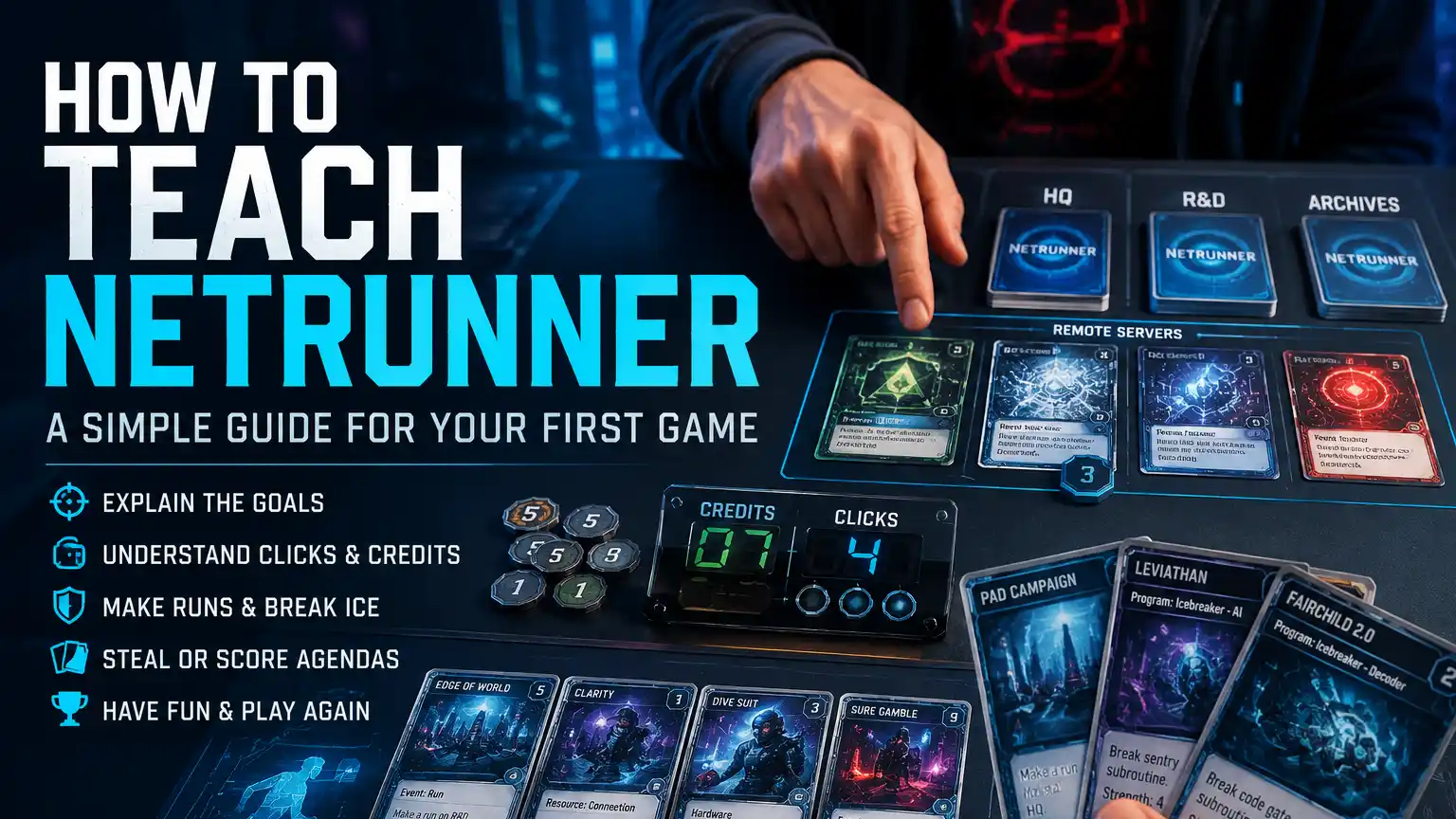
Teaching Netrunner is its own little puzzle.
The game is not impossible to learn. The basic idea is actually very clean: the Corp is trying to score agendas, and the Runner is trying to steal them. The problem is that Netrunner has a lot of small pieces that all sound important at the same time. Credits. Clicks. Servers. Ice. Icebreakers. Tags. Damage. Agendas. Runs. Access. Rezzing. Trashing. Deckbuilding. Formats.
If you explain all of that before the first turn, the new player is already gone.
The best way to teach Netrunner to a new player is not to explain the whole game. It is to create one good first game. A first game should feel tense, readable, and a little mysterious without becoming a rules seminar.
This guide is a practical teaching plan for getting someone from “I have heard Netrunner is cool” to “I want to play another game.”
Start With The Right Goal
Your goal is not to make the new player good at Netrunner in one sitting.
Your goal is much simpler:
- They understand what the Corp wants.
- They understand what the Runner wants.
- They make a few real runs.
- They see ice and icebreakers interact.
- They steal or score at least one agenda.
- They finish the game wanting another one.
That is enough.
A lot of experienced players accidentally teach too much because they love the game. They want to explain why the matchup is interesting, why the deck is built a certain way, why one agenda is better than another, and why a bad run can still be correct.
Save that for later.
The first teach should answer one question: “What am I trying to do on my turn?”
Use A Small Teaching Setup
Do not start a new player with a full Standard deck, a tournament list, a huge card pool, or a stack of unfamiliar staples.
Use a small prepared teaching setup. System Gateway is the cleanest starting point because it was built for learning the game. It gives both players enough real Netrunner texture without asking them to understand every faction, format, or deckbuilding rule right away.
For a first game, you want:
- One Runner deck
- One Corp deck
- Credits or tokens
- A simple click tracker
- Opaque sleeves if you are mixing printed cards and other cards
- A patient teacher
- No pressure to play perfectly
If you are printing decks for a new player, keep the first pair simple and readable. Do not hand them a deck that wins through a strange combo, complicated tag punishment, or a plan that only makes sense after twenty games. A first deck should show the game’s core loop: build, run, rez, break, access, score.
Teach The Story Before The Rules
Before explaining clicks or card types, explain the story of the game.
Try this:
Netrunner is a two-player cyberpunk card game. One player is the Corp. The Corp has secret agendas and is trying to score them. The other player is the Runner. The Runner is trying to break into the Corp’s servers and steal those agendas before the Corp can finish them.
That is the whole pitch.
Then add the important twist:
The Corp plays many cards face down. The Runner often has to decide whether to run into unknown danger.
That one sentence does more work than a long explanation of card types. It tells the new player why the game is exciting. The Corp is hiding things. The Runner is poking at them. Everyone is making decisions with incomplete information.
Explain The Win Conditions Early
A new player needs to know how the game ends before they can make sense of any turn.
Keep it simple:
- The Corp usually wins by scoring 7 agenda points.
- The Runner usually wins by stealing 7 agenda points.
- The Corp can also win by flatlining the Runner with damage.
- The Runner can also win if the Corp runs out of cards when forced to draw.
Do not explain every possible damage type yet. Do not explain every weird alternate win condition. Just make sure both players understand that agendas are the main scoreboard.
Once they know that, every run and every remote server starts to make sense.
Teach Clicks And Credits Next
After the goal, explain the two basic resources.
Clicks are actions. Credits are money.
That is enough for the first pass.
The Corp uses clicks to draw, gain credits, install cards, advance agendas, and build servers. The Runner uses clicks to draw, gain credits, install cards, play events, and make runs.
Credits pay for cards and abilities. The Corp spends credits to rez ice and assets. The Runner spends credits to install tools and break through ice.
A new player does not need to know every paid ability window right away. They just need to know this:
- Clicks decide how much you can do.
- Credits decide what you can afford.
- A turn is usually about spending both well.
Show The Corp Side First
The Corp is the stranger side for most new players because it plays cards face down and builds servers. Even if the new player is going to play Runner first, show the Corp’s basic setup.
Lay out the Corp zones:
- HQ is the Corp’s hand.
- R&D is the Corp’s deck.
- Archives is the Corp’s discard pile.
- Remote servers are created during the game.
- Ice protects servers.
Then show one simple scoring plan:
- The Corp installs ice protecting a remote server.
- The Corp installs an agenda in that remote.
- The Corp advances the agenda.
- The Corp scores it once it has enough advancement counters.
That little demonstration is huge. It shows the new player what the Corp is trying to build and why the Runner cares about checking remotes.
Then Show What A Run Is
Now explain the Runner’s core action: making a run.
A run is an attack on one of the Corp’s servers. The Runner chooses a server, approaches any protecting ice, deals with that ice if it is rezzed, and then accesses cards if they get through.
Keep the first run simple. Do not start with three pieces of ice and five timing windows.
Use one server and one piece of ice.
Walk through it like this:
- Runner spends a click to run the remote.
- Runner approaches the ice.
- Corp decides whether to rez the ice by paying its cost.
- If the ice is rezzed, its subroutines matter.
- Runner uses an icebreaker if they have one.
- If the Runner gets through, they access the card in the server.
- If it is an agenda, they steal it.
That is the first “aha” moment. The Runner now sees why money matters. The Corp now sees why defending costs money. Both sides see why running unknown servers is scary and exciting.
Explain Ice And Icebreakers Only When They Matter
Do not frontload every detail about ice types.
The new player does not need a lecture on barriers, code gates, sentries, AI breakers, strength, subroutines, and encounter timing before the first run. They need a working model.
Use this version:
Ice is the Corp’s defense. Icebreakers are the Runner’s tools for getting through that defense.
Then add the key mechanical idea:
The Runner usually needs the right kind of icebreaker and enough credits to break the important subroutines.
When a specific piece of ice appears, explain that card. When a specific breaker is installed, explain that breaker. Teaching from the board is much easier than teaching from a rulebook.
A new player will remember “this program breaks this kind of ice” better than they will remember a complete taxonomy of ice types.
Play The First Few Turns Open-Handed
Hidden information is one of Netrunner’s best features, but it can make the first game confusing. For a teaching game, it is fine to play the first few turns with open hands or semi-open information.
That might mean:
- The teacher shows their hand.
- The teacher explains why they are installing a card.
- The teacher warns when a run is obviously pointless.
- The teacher says, “This is a trap, but I want to show you how traps work.”
- The teacher asks, “What do you think the Corp is trying to do here?”
You are not trying to win the first teaching game through secrecy. You are trying to let the new player see the machine working.
After a few turns, you can close the hands and let the game become more natural.
Give The New Player Runner First
Both sides are fun, but Runner is usually easier for a first emotional experience.
The Runner gets to do the thing that feels exciting: run at servers and reveal hidden cards. They get to ask, “What is over there?” and then find out. That is the heart of Netrunner.
The Corp is more subtle. The Corp must manage hidden information, tempo, scoring windows, and bluffing. That is great, but it can be harder as a first exposure.
A good teaching sequence is:
- Game 1: New player plays Runner.
- Game 2: New player plays Corp with help.
- Game 3: Switch back and let them choose.
Once they have seen both sides, the whole game becomes clearer.
Do Not Over-Coach Every Decision
This is the hardest part for experienced players.
Do not turn every new player decision into a strategy lecture.
If they ask what to do, help. But avoid stopping the game every turn to explain the best line. New players need to feel ownership. They need to make a risky run, get punished, laugh, and remember it. They need to ignore R&D for too long and then realize the Corp has been drawing agendas. They need to spend too many credits and feel broke.
Those little mistakes are the lesson.
A good teacher gives enough context to keep the game fair, not enough instruction to turn the new player into a passenger.
What To Explain During Game One
During the first game, focus on the concepts that immediately affect the board.
Teach these:
Agendas
Agendas are the points. The Corp scores them. The Runner steals them.
Servers
The Corp has central servers and remote servers. The Runner chooses where to run.
Ice
Ice protects servers and creates costs, risks, or barriers.
Icebreakers
Icebreakers let the Runner get through ice, usually by matching type and paying credits.
Credits
Credits are not just money. They are threat. A rich Corp can rez ice. A rich Runner can contest servers.
Clicks
Every action has an opportunity cost. If you spend four clicks setting up, you are not running. If the Corp spends four clicks drawing and taking credits, they are not scoring.
Damage
Damage matters because if the Runner has to take more damage than they have cards in hand, they lose.
That is plenty for one game.
What To Save For Later
Do not explain everything just because it exists.
Save these for later games:
- Full deckbuilding rules
- Influence
- Rotation
- Ban lists
- Tournament formats
- Advanced timing windows
- Every damage type in detail
- Niche card interactions
- Meta decks
- Complex tag punishment
- Unusual alternate win plans
- Deep faction identity strategy
These are important, but they are not first-game material.
The first game is about the loop. Corp builds. Runner runs. Corp taxes. Runner breaks. Agendas move. Credits matter. Hidden information creates tension.
A Simple First-Game Teaching Script
Here is a clean way to teach Netrunner to a new player without drowning them in rules.
Step 1: Explain the premise
Corp hides and scores agendas. Runner runs and steals agendas. First to 7 usually wins.
Step 2: Show the table layout
Point to HQ, R&D, Archives, and remotes. Show where installed Runner cards go.
Step 3: Explain clicks and credits
Each turn is built from actions and money. You will explain exact options as they appear.
Step 4: Demonstrate a Corp turn
Install ice. Install a card in a remote. Take credits or advance.
Step 5: Demonstrate a Runner turn
Install a breaker or economy card. Make a run. Access something.
Step 6: Walk through one ice encounter slowly
Rez the ice, read the subroutines, show how the Runner breaks them or suffers them.
Step 7: Play normally, but narrate your thinking
Say things like:
- “I am protecting this server because it might become important.”
- “You are low on credits, so this is a good scoring window for me.”
- “You can run there, but if I rez the ice, you may not be able to afford it.”
- “Checking HQ is useful because agendas can sit in the Corp’s hand.”
Step 8: Debrief after the game
Do not analyze every mistake. Ask three questions:
- What part made sense?
- What part felt confusing?
- Which side do you want to try next?
That debrief will tell you what to teach in game two.
Common Teaching Mistakes
Starting With Deckbuilding
Deckbuilding is one of the best parts of Netrunner, but it is not the best first step. A brand-new player cannot evaluate cards until they understand what a normal turn feels like.
Play first. Build later.
Explaining Too Many Card Types Up Front
The Corp has operations, assets, agendas, upgrades, and ice. The Runner has events, resources, hardware, and programs. That sounds manageable to an experienced player. To a new player, it sounds like homework.
Introduce card types as they appear.
Using A Deck That Is Too Clever
A teaching deck should be honest. It should show the main game. Avoid decks that win through a narrow combo, a strange lock, or a plan that requires the new player to already understand the meta.
Playing Too Hard
You can still make real decisions, but do not crush a first-time player just because they ran last click into danger. The point is to create a good experience, not prove that Netrunner has teeth.
It has teeth. They will find out soon enough.
Correcting Every Vocabulary Mistake
If a new player says “attack” instead of “run,” let it go. If they say “mana” instead of “credits,” let it go. Correct only when the wording affects the rules.
Fluency comes with games played.
When To Introduce Printing And Decklists
After the new player has played a couple of games, they may ask the best question:
“What should we play next?”
That is the right time to introduce printed decks, decklists, and a broader card pool.
A good next step is to print a small set of balanced beginner decks so the new player can try different styles without building from scratch. You might prepare:
- One straightforward Runner deck
- One aggressive Runner deck
- One glacier-style Corp deck
- One faster scoring Corp deck
- One trap-heavy Corp deck, once they understand damage
This is where a printed Netrunner deck or small shared card pool becomes useful. Instead of asking a new player to buy singles, track down old cards, or immediately learn every legal set, you can create a controlled learning environment.
The goal is not to give them everything. The goal is to give them enough variety that they can say, “I like this style.”
What To Teach In Game Two
Game two is where you can add one or two new layers.
Good game-two topics include:
- Why central servers matter
- Why the Corp sometimes leaves a remote undefended
- Why the Runner should pressure R&D or HQ
- How tags can become dangerous
- Why staying rich matters
- How to identify a scoring window
- Why not every run needs to steal an agenda to be useful
Do not teach all of those at once. Pick the one that came up naturally in game one.
If the new player kept running remotes and ignoring centrals, teach central pressure. If they went broke every turn, teach credit discipline. If they never challenged a remote, teach scoring windows.
Let their mistakes choose the lesson.
What To Teach In Game Three
By game three, the player usually understands the basic rhythm. Now you can introduce choice.
This is a good time to ask:
- Do you like being Runner or Corp more?
- Do you like direct pressure or slower setup?
- Do you like bluffing?
- Do you like making money and building a big board?
- Do you want simple decks or trickier ones?
Their answers can guide what you print, build, or teach next.
This is also where you can introduce the idea that Netrunner has different formats and card pools. Keep it light. Explain that some groups play smaller beginner-friendly formats, while others play larger competitive formats. The new player does not need to memorize legal sets yet. They just need to know that decklists should match the format they plan to play.
A Good First Night Of Netrunner
A strong first Netrunner night might look like this:
- 10 minutes explaining the premise and table layout
- 45 minutes playing a guided first game
- 10 minutes talking through what happened
- 45 minutes switching sides for a second game
- 10 minutes choosing what to try next time
That is a great session.
Do not worry if the first game is messy. It will be. The new player will forget clicks. The Corp will forget to rez something. The Runner will run a server they cannot afford. Someone will misunderstand a subroutine. That is normal.
The goal is not a flawless rules demonstration. The goal is a memorable first contact with the game.
FAQ
What is the easiest way to teach Netrunner to a new player?
The easiest way is to use a small teaching card pool, explain the Corp vs Runner goal first, then play a guided game where you introduce rules as they appear. Do not start with deckbuilding or formats.
Should a new player start as Runner or Corp?
Runner is usually the easier first experience because the action is more direct. The Runner makes runs, reveals hidden cards, and sees the tension of the game quickly. The Corp is great for game two once the player understands what the Runner is trying to attack.
Should the first teaching game be open-hand?
It can help. Playing with open hands for the first few turns makes the game less mysterious while the new player learns the flow. Once they understand the basics, you can restore hidden information.
How many games does it take to understand Netrunner?
Most players can understand the basic loop after one game, but it takes several games before the strategy starts to feel natural. That is part of the appeal. Netrunner gets better as players learn how to read each other.
Should I teach deckbuilding right away?
No. Teach gameplay first. Once the new player understands runs, servers, ice, agendas, and credits, deckbuilding becomes much easier to understand.
Final Thoughts
The best way to teach Netrunner to a new player is to protect the first experience.
Do not make them learn the whole game before they play. Do not bury them in deckbuilding. Do not explain the entire card pool. Give them a clean first game, a clear goal, and enough room to make real decisions.
Netrunner is at its best when both players feel like they are discovering something: a hidden agenda, a risky run, a bluff, a scoring window, a mistake that suddenly matters.
Teach that feeling first.
The rules can catch up later.